
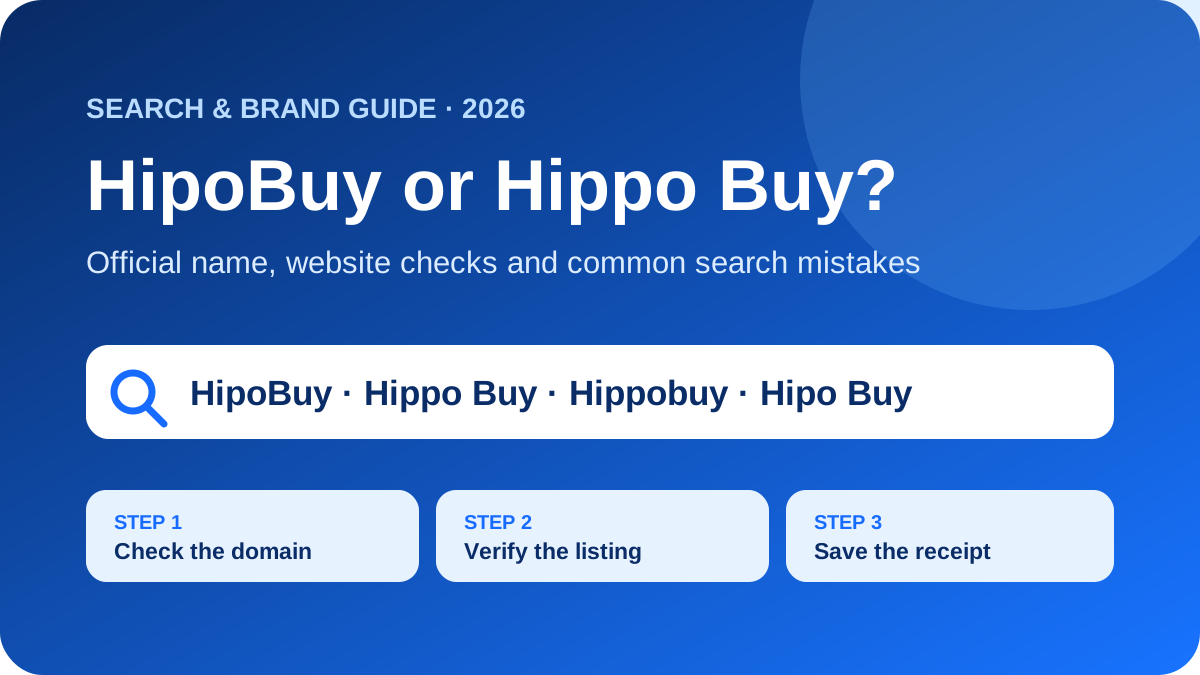
The short answer is that the service styles its name as HipoBuy: one word, one “p,” and a capital “B.” Searchers often type Hippo Buy, Hippobuy, Hipo Buy, or even Hypobuy because the brand sounds like the common English word “hippo.” Search engines usually understand the intent, but the spelling difference matters when you verify a website, save a login, follow a product link, or compare an order record.
A spelling mistake is harmless when it only changes a search query. It becomes risky when it leads to a look-alike domain, an unofficial social profile, an outdated promotion, or a page that asks for credentials. This guide separates search variations from identity checks so you can find information without treating every similar name as the same destination.
What is the correct HipoBuy spelling?
The brand name displayed in current public HipoBuy materials is HipoBuy. The recognizable parts are “Hipo” and “Buy,” joined without a space. That is the spelling to use in account notes, bookmarks, customer-service messages, parcel records, and searches where precision matters.
Several alternatives describe the same search intent but are not the styled brand name. “Hippo Buy” inserts a second p and a space. “Hippobuy” joins that variation. “Hipo Buy” adds a space. “Hypobuy” replaces the first i with y. These variants are useful keyword clues because real users type them, but a careful guide should not present them as separate companies without evidence.
Capitalization is less important in a browser address or search box. HipoBuy, hipobuy, and HIPOBUY can point to the same text intent. Spacing and extra letters matter more when you are visually checking a domain or sender name.
Why do so many people search Hippo Buy or Hippobuy?
People write unfamiliar names by sound. “Hippo” is a familiar animal word, while “Hipo” looks incomplete to many English speakers. Autocorrect can add the second p, split the brand into two words, or replace the i. Social captions and short videos may also use an informal spelling that later becomes a repeated query.
This explains why terms such as hippo buy spreadsheet, hippobuy spreadsheet, hipo buy shop, and hipobuy login can all reflect related needs. One person wants a curated product directory. Another wants the shopping interface. A third is trying to return to an account. The words overlap, but the safest answer depends on the task.
For discovery, search broadly and then verify narrowly. A spelling variant can help you find a guide, but it should never be the only evidence that a payment or login page is genuine.
How to verify the website before logging in
Read the complete domain in the browser address bar, not only the page logo. A logo, color palette, screenshot, or ad headline can be copied. The domain is a stronger identity signal, although it should still be combined with sensible account and payment checks.
- Open the site from a bookmark you created after a successful verification, or type the domain carefully.
- Confirm the connection uses HTTPS and the browser shows no certificate warning.
- Check that navigation, help pages, policy pages, and account flows are internally consistent.
- Do not enter a password after following an unexpected direct message, shortened link, or pop-up.
- Use a unique password and store it with the exact domain in a trusted password manager.
A padlock alone does not prove that a business is trustworthy; it only shows that the connection is encrypted for that domain. Likewise, a polished homepage does not prove that a product seller, shipping route, or coupon is suitable. Verification is a chain, not a single badge.
What does “HipoBuy spreadsheet” mean?
A HipoBuy spreadsheet is a discovery layer that organizes product leads. It may group items by category, show a reference image and price, and provide a path to a product detail page. It is not a promise that the seller still offers the same variation, price, quality, or stock.
When someone searches hippo buy spreadsheet or hipo buy spreadsheet, the underlying need is usually speed: they want to browse without translating thousands of marketplace listings. A good spreadsheet helps narrow options, but every result still needs a live check.
Compare the current product title, selected variation, price, seller information, domestic delivery and available photos with the spreadsheet card. If any important detail differs, treat the current product page as the active record. Save a screenshot or note of the exact option you intend to order so the later warehouse item can be compared with it.
Avoid HipoBuy login and account mistakes
Login searches are especially sensitive because they place the user close to entering credentials. If you search “hipobuy login,” do not assume the first advertisement or similarly named result is correct. Inspect the destination first. Password managers can help because they normally offer credentials only on the domain where they were saved.
Never reuse the email password for a shopping-agent account. If the service supports additional security settings, enable them. Keep order confirmations and payment receipts outside the account as well. An independent record gives you a timeline if a status, price, address or parcel instruction later needs clarification.
Account safety also includes recipient data. Before parcel submission, verify the recipient name, complete address, phone number, postal code and destination country. A correctly spelled brand does not protect against a wrongly typed delivery detail.
How to evaluate a HipoBuy shop or product page
“HipoBuy shop” can mean the agent interface, a curated directory, or the underlying marketplace seller. Keep those layers separate. The agent facilitates purchasing and warehousing; the marketplace seller supplies the item; the directory helps discovery. A positive impression of one layer should not automatically transfer to the others.
Before payment, record the source link, exact color, size, quantity, listed price and any objective buyer note. Avoid vague instructions such as “best quality.” Use observable requirements: correct label size, specific color, included strap, measured insole, or no crushed retail box.
After warehouse arrival, match the QC evidence against that record. Start with identity, then visible condition, then measurements. Photos cannot prove authenticity, internal materials or long-term durability. Their value is reducing visible mismatch before international shipping, when a domestic return may still be possible.
Search-result red flags worth pausing for
Pause if a page creates urgency around a permanent-looking coupon, asks for payment through an unrelated personal account, requests a password in chat, hides the destination behind repeated redirects, or makes guarantees that cannot be checked in the live order flow. Promotions, routes and fees change, so a screenshot from months ago is not a current quotation.
Also pause when a guide uses “official” without showing what it means. An independent review can summarize public information, but it should not imply ownership or endorsement. Look for clear disclosure, updated dates, limitations, and reminders to check the live interface.
A safer search-to-order workflow
- Search using the phrase that comes naturally, including a spelling variant if necessary.
- Identify whether the result is an official service page, independent guide, product directory, or marketplace listing.
- Verify the complete destination domain before login or payment.
- Open the live product record and confirm variation, price and availability.
- Save the order evidence and use precise purchasing instructions.
- Compare warehouse QC with the evidence before approving international shipping.
- Review packed weight, dimensions, route restrictions and final payable amount.
This sequence is more useful than memorizing one spelling alone. The correct name helps you start; verification at each handoff helps you finish safely.
Keep the same discipline when returning later. Old bookmarks can point to discontinued campaigns, cached product records, or paths that now redirect. Reopen the saved destination, inspect the final address, and confirm that the page still serves the purpose you expect. If you share a link with another buyer, describe whether it is a guide, directory result, account page, or marketplace product instead of calling every destination “the HipoBuy link.” Clear labels reduce accidental login attempts on informational pages and prevent product leads from being mistaken for official guarantees.
Search spelling also matters in support requests. Include the exact order or parcel identifier rather than relying on the product nickname. Write the problem in observable terms, attach the relevant screen, and state the outcome you want. A precise record is easier to investigate than a message built around a loosely spelled brand name.
Final answer: HipoBuy, Hippo Buy or Hippobuy?
Use HipoBuy when you mean the styled brand name. Treat Hippo Buy, Hippobuy, Hipo Buy and Hypobuy as common search variations, not as proof of a separate service. Search engines may connect the phrases, but you should still inspect the exact domain and the purpose of each page.
For a spreadsheet, confirm every live listing. For a login, verify the destination before entering credentials. For a purchase, keep the selected variation and payment record. For warehouse approval, compare QC evidence with the original order. Correct spelling improves discovery; a repeatable verification method protects the transaction.