
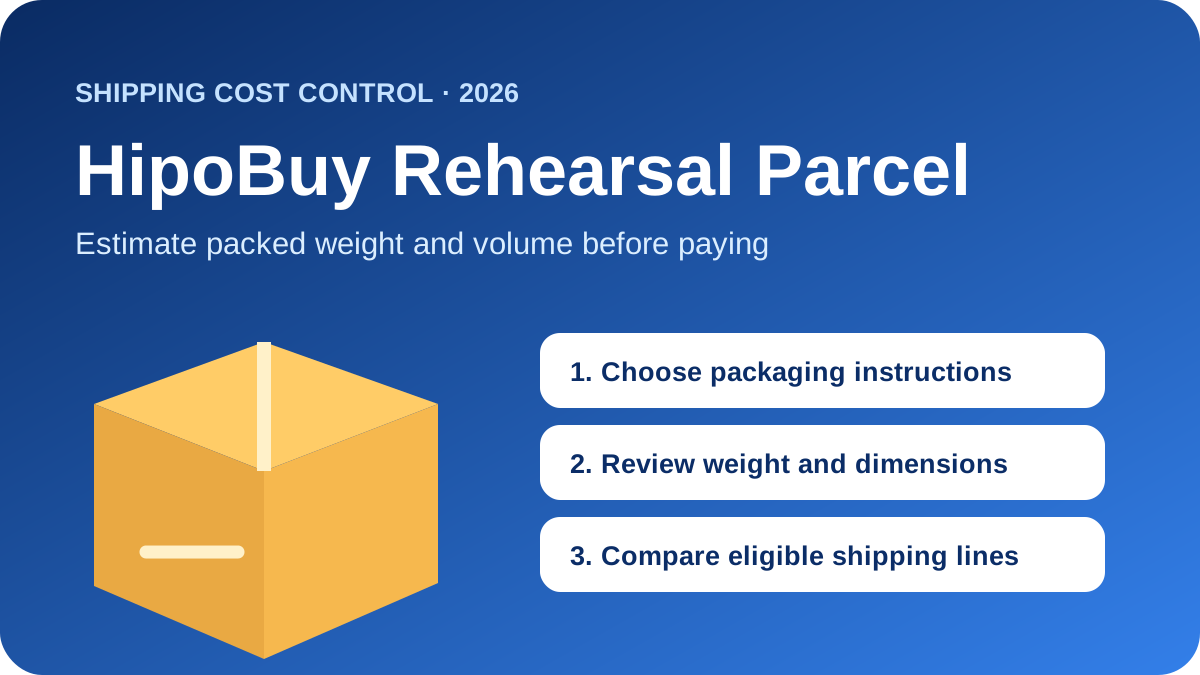
A rehearsal parcel is valuable because it turns an abstract shipping estimate into a preview based on a proposed package. Instead of guessing from product-page weights, the warehouse can prepare or model the parcel, apply packing instructions, and produce measurements that are closer to the shipment you may actually buy. HipoBuy’s public homepage currently announces a Rehearsal Parcel feature, making this an important checkpoint for buyers who want to understand chargeable weight before international payment.
The feature does not make shipping cost perfectly predictable. Rates, route availability, fuel adjustments, customs rules and carrier calculations can still change. Its purpose is to reduce uncertainty about the part you can control: what goes into the box, how it is packed, how much it weighs, how much space it occupies and which lines can accept it.
What a HipoBuy rehearsal parcel is for
Before rehearsal, an estimate may depend on seller data, expected product weight or rough dimensions. Those inputs can be wrong or incomplete. A pair of shoes may arrive with a heavy presentation box. A puffer jacket may occupy far more volume than its scale weight suggests. Protective foam can expand a fragile parcel, while removing unnecessary retail packaging can shrink an ordinary clothing order.
Rehearsal brings these choices forward. You identify the warehouse items, provide packaging preferences, and receive more specific parcel information before selecting or paying for international shipping. The result helps answer three questions: Is the parcel arranged as intended? What is likely to determine chargeable weight? Which currently eligible route gives the best trade-off?
Check the live HipoBuy account for the current name, fee, processing time and exact output of the service. A public feature announcement does not guarantee that every account, warehouse item or route has identical terms.
Prepare before requesting rehearsal
Do not begin by selecting every item in storage. Build a parcel brief. Group products that share a destination, time requirement and compatible shipping conditions. Separate liquids, fragrances, batteries, magnets, powders or other sensitive goods if they would eliminate useful routes for ordinary clothing.
Complete product-level decisions first. Confirm that each item passed identity and visible-condition checks. Resolve returns, exchanges and measurement questions. Rehearsing a parcel that still contains an undecided item wastes time and can make the later weight obsolete.
Then give objective packaging instructions. Useful examples include remove the outer shoe box, keep the collectible box, fold ordinary garments, do not compress a structured bag, add corner protection to a fragile box, or isolate metal hardware from a delicate surface. Avoid asking for both maximum protection and minimum volume without identifying which matters more.
Actual weight versus volumetric weight
Actual weight is the scale reading of the packed parcel. Volumetric or dimensional weight represents the space the parcel occupies. Many lines calculate a dimensional figure from length, width and height, then charge according to the greater of scale weight and dimensional weight.
The divisor and rounding method can differ by line. Do not assume one internet formula applies everywhere. Use your own calculation only to diagnose why the parcel looks expensive; use the current line quotation for the payable decision.
Imagine a parcel that weighs 5 kilograms but occupies a large rectangular box. If a route calculates a dimensional result of 8 kilograms, the parcel may be charged closer to 8. Removing empty packaging or choosing a more compact arrangement could have more effect than removing a few hundred grams. A dense 5-kilogram parcel in a small box may remain controlled by actual weight instead.
Packaging choices that change the result
Shoe boxes, gift boxes, air pillows, foam frames and separate retail cartons are common volume drivers. Removing them can lower dimensional weight, but not every box is waste. Original packaging may protect a collectible, support a structured product or matter to the intended recipient.
Compression is useful for suitable textiles but risky for down construction, delicate prints, structured bags, technical membranes and anything that can crease permanently. Heavy shoes should not press against fragile electronics or hardware. Small accessories need containment so they are not lost inside a larger box.
Choose packaging according to the cost of damage, not only the freight saving. An extra layer that prevents a high-value item from breaking can be economical. Maximum reinforcement on every low-risk garment can be expensive and unnecessary. The rehearsal request should express priorities item by item.
How to review the rehearsal result
When the result appears, compare it with your warehouse list. Confirm every intended item is included and no unresolved item slipped into the parcel. Review any packaging photos or notes available in the account. Look for obvious empty space, avoidable retail boxes, crushing risk and incompatible products.
Check whether the measurements are plausible. A parcel containing several shoes will be larger than a clothing-only parcel. A single flat garment should not normally create an enormous box without an explanation. If a measurement looks unreasonable, ask for clarification through the live order workflow rather than assuming an error.
Record the weight and dimensions before comparing routes. This gives you a baseline if you later remove an item, change packaging or split the order. It also improves future estimates for similar hauls to the same destination.
Compare eligible shipping lines after rehearsal
Start with eligibility. A cheap route is irrelevant if it does not accept the goods, size, weight or destination. Then compare the final chargeable weight, total payable freight, delivery estimate, tracking, compensation, tax handling and restrictions.
Do not select a line only because a coupon applies. HipoBuy’s public pages may promote shipping bonuses or discounts, but promotions have thresholds, destinations, expiration dates and eligible services. Compare the amount after the discount with all other suitable lines.
A slower tracked line may fit a low-value clothing parcel. A time-sensitive gift may justify a higher price for a stronger delivery estimate. A valuable or fragile parcel may need better compensation terms. Rehearsal improves the input, but route choice still depends on the buyer’s objective.
When splitting the parcel can cost less or reduce risk
Consolidation can reduce repeated base charges, but one large mixed parcel is not always optimal. A battery accessory can remove clothing-friendly routes. A bulky lightweight product can raise volumetric weight for everything. A fragile item can force reinforcement around an otherwise compressible parcel.
Compare one combined rehearsal with a logical split when the account permits it. Group ordinary compact clothing together. Consider separating restricted goods, urgent items, high-value products or pieces that require incompatible packing. The split may increase base costs but recover route eligibility, reduce damage risk or prevent one delayed item from holding the entire order.
Do not split randomly. Each parcel creates its own tracking, customs and minimum-charge exposure. The goal is operational compatibility, not the smallest possible item count.
Common rehearsal parcel mistakes
- Requesting rehearsal before returns or QC questions are resolved.
- Keeping every retail box by default without valuing it.
- Removing protective packaging from fragile or collectible goods.
- Ignoring dimensions and comparing routes only by actual kilograms.
- Combining sensitive goods with ordinary items before checking route impact.
- Choosing a more expensive line only to use a coupon.
- Treating the rehearsal estimate as immune to later rate or carrier changes.
- Failing to save the result for comparison with the final parcel record.
A repeatable rehearsal parcel workflow
- Finish item-level QC and domestic return decisions.
- Group products by destination, timing, restrictions, fragility and compression tolerance.
- Write one clear packing instruction for each product that needs special treatment.
- Request rehearsal using the current account process and review any fee or processing time.
- Confirm contents, weight, length, width, height and visible packing arrangement.
- Identify whether scale weight or parcel volume is driving the quote.
- Test a sensible packaging change or parcel split if the result is inefficient.
- Compare only eligible lines using total payable cost and risk terms.
- Apply a valid discount after the route already makes sense.
- Save the final measurements, line, payment and tracking record.
Final perspective
HipoBuy rehearsal parcel information is most useful as a control point, not a promise. It moves the buyer from rough product estimates toward a measured package and makes the relationship between packing, volume, eligibility and price easier to inspect.
The best result comes from good preparation. Resolve QC first, design a compatible parcel, state packaging priorities, inspect all dimensions, and compare the final eligible routes. If volume or restrictions create an inefficient package, revise before payment while the choices remain flexible.
A buyer cannot control every carrier rate or customs event. A buyer can control which items are grouped, which boxes are kept, what gets compressed, which measurements are questioned and which route is accepted. That is the real value of rehearsal.