
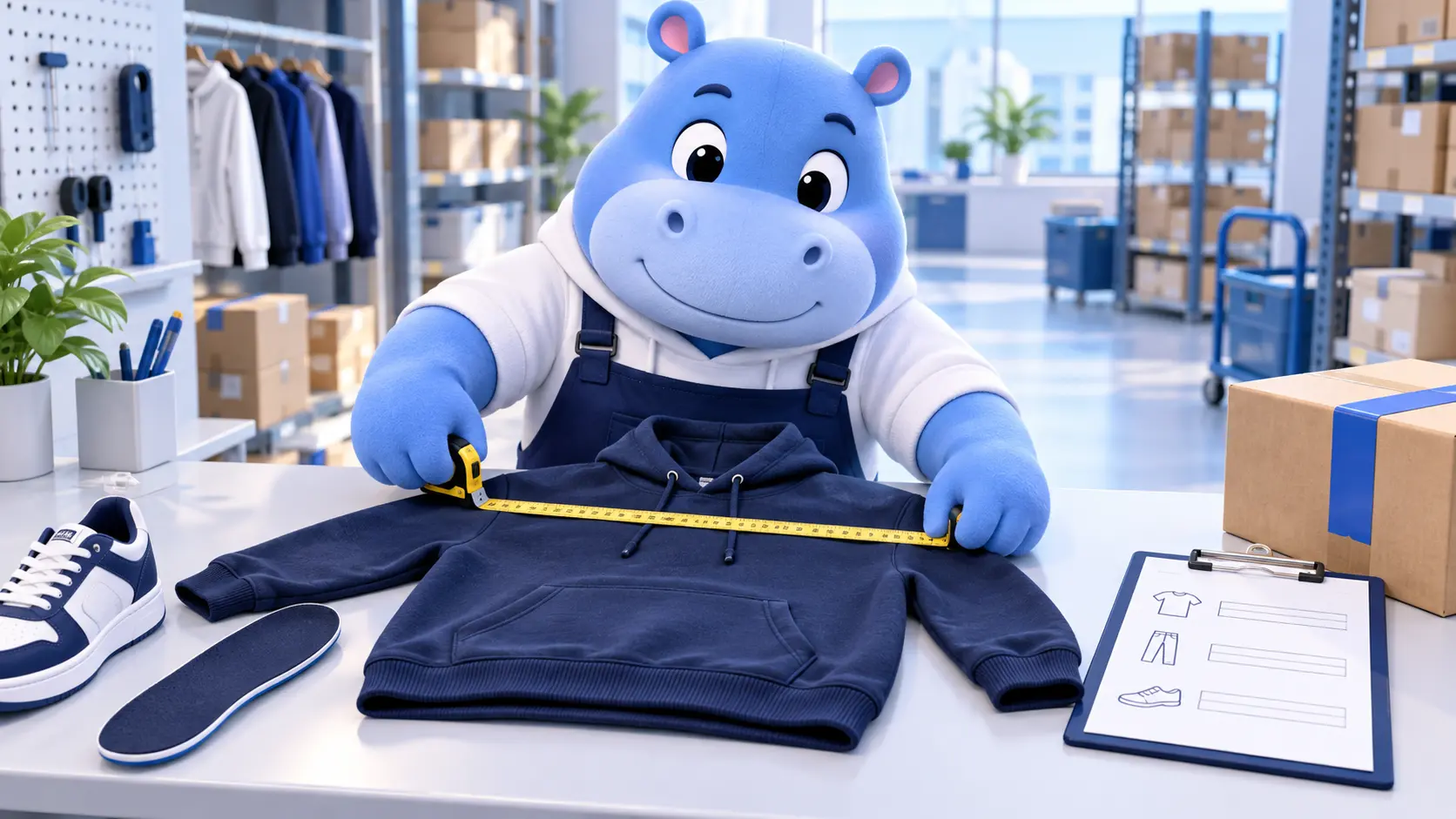
A size label feels precise until the parcel arrives. One seller’s large can fit like another seller’s medium, a relaxed hoodie may be wider but shorter than expected, and a shoe marked with the right European number can still have the wrong usable interior length. In reverse purchasing, the expensive mistake is not choosing the “wrong letter.” It is approving international shipping without enough measurement evidence to understand the fit.
HipoBuy’s current public app descriptions say the service helps users purchase from marketplaces such as Taobao and 1688, provides professional buyer support, offers 90 days of free storage, and emphasizes QC-photo discovery. Those checkpoints do not turn seller size labels into one universal standard.
This guide uses a measurement-first system. Instead of asking whether you “usually wear L,” it builds a record from a garment or shoe that already fits, compares that record with the live seller chart, locks the selected variation, and then uses warehouse evidence to catch decision-changing differences before the item enters an international parcel.
Separate body size from product size
The first sizing decision is choosing what you are actually comparing. Body measurements describe you. Product measurements describe the finished garment or shoe. Mixing the two creates false confidence.
If your chest measures 100 cm, that does not mean a T-shirt measuring 100 cm around the chest will feel comfortable. Clothing needs ease: extra room that allows movement and creates the intended silhouette. A slim tee, heavy hoodie, and winter jacket can all fit the same person while having very different finished measurements.
Use a product you already own as your primary reference. Lay it flat without stretching it and record the same dimensions shown on the seller’s chart. This captures both your body and your preferred ease in one practical benchmark.
Build a personal reference sheet before browsing
Create separate reference rows for the product types you buy most often. For tops, record chest width from armpit to armpit, shoulder width, back length, and sleeve length. For pants, record flat waist width, front rise, outseam or inseam, thigh width, and leg opening. For shoes, record the manufacturer size of a reliable pair and the removable insole length when possible.
Do not build the sheet from memory. Keep the item flat and note exactly where every measurement begins and ends; a sleeve measured from the collar is not comparable with one measured from the shoulder seam.
Add a tolerance beside every number. You may accept a hoodie chest that is 2 cm wider than your reference but reject one that is 3 cm shorter. Tolerance makes a later warehouse decision faster because you have already decided which differences matter.
Read the seller chart as a method, not just a table
A useful size chart needs three things: the unit, the measurement points, and the size-to-variation mapping. Confirm whether the numbers are centimeters or inches and whether a chest figure means flat width or full circumference. A 58 cm flat chest is roughly 116 cm around, but only if the seller measured straight across the garment.
Look for small notes about manual-measurement tolerance, fabric stretch, model fit, or the way length is taken. Translation can make labels ambiguous, so compare the diagram with the numbers rather than trusting a translated heading alone.
If a listing presents conflicting charts, ask which one applies to the exact color, version, and batch you selected.
Match the chart to the exact variation
Marketplace listings often combine several versions under one product page. A fleece-lined option may use a different cut from the lightweight option. Men’s, women’s, youth, regular, and oversized versions may share pictures while using different measurements.
Before payment, save the selected color, size, version, quantity, relevant chart, and one identifying product image. Write a short buyer instruction such as: “Navy, fleece-lined version, size XL from the second size chart; do not substitute another version or size without confirmation.”
HipoBuy’s public app information advertises professional purchasing support. That support is most effective when your note contains a verifiable rule rather than a vague request to “choose the best fit.” The purchasing agent can confirm an option; they cannot know how much room you personally prefer.
Use different checks for tops, pants, and shoes
For T-shirts, hoodies, and jackets, chest width usually controls closure and drape, while length can change the entire look. Compare a dropped-shoulder hoodie with a similar garment rather than a fitted sweatshirt.
For pants, understand whether the waist number is a flat width or full circumference. Check the rise because it changes where the waistband sits, and do not confuse outseam with inseam. Elastic waists can stretch, but a relaxed maximum does not tell you whether the unstretched waistband will stay comfortably in place.
For footwear, do not convert between US, UK, EU, and Chinese sizes with a generic chart and stop there. Use the seller’s stated foot-length method, then compare insole length when available. Foot length, insole length, and outsole length are not interchangeable. Thick lining, a narrow toe box, or a fixed insole can also change usable space.
Turn QC photos into measurement evidence
A standard warehouse photo may confirm color, visible condition, and the attached size tag while still leaving the real dimensions unknown. A tag proves which label arrived; it does not prove the product matches the seller chart.
If a measurement could change your keep-or-return decision, request evidence that shows the entire tape, both endpoints, and the garment laid naturally. Ask for one precise dimension at a time: “Please measure chest width from armpit to armpit with the hoodie flat,” or “Please photograph the removable insole beside a metric tape from heel to toe.”
Check the live HipoBuy order interface for the current availability and cost of any additional photo or measurement service. Public marketing pages do not establish a permanent allowance or price for every order.
Decide with tolerance, not perfection
Seller charts and warehouse measurements can differ slightly because of fabric behavior, measurement technique, or production variation. The useful question is not whether every number is identical. It is whether the difference crosses your pre-set tolerance.
Suppose your preferred hoodie has a 60 cm flat chest and 70 cm back length. The seller chart shows 61 and 70, while the warehouse photo shows approximately 60 and 67. A one-centimeter chest difference may be harmless, but a three-centimeter length loss may matter if cropped proportions are your stop condition.
Record the result as approve, clarify, exchange, or return. Do not submit the item in a parcel while the decision is unresolved.
Keep the storage clock and return clock separate
HipoBuy’s official app listings currently advertise 90 days of free storage. That window can help several purchases arrive before consolidation, but it should not be interpreted as a universal 90-day seller return period.
Inspect fit-critical items promptly. Seller return eligibility, domestic shipping cost, and timing may depend on the specific marketplace order. If a measurement is outside tolerance, ask HipoBuy support about the current options before waiting for the rest of the haul.
Storage is for coordinated parcel planning. It is not a reason to postpone a sizing decision that may have a shorter remedy window.
Include fit risk in landed cost
A cheap item that cannot be worn is not a bargain, and international shipping makes the sizing mistake more expensive. Consider the product price, domestic delivery, measurement or photo costs if applicable, return freight, replacement delay, and the item’s share of international shipping.
If two sizes seem equally plausible, buying both adds parcel weight and another return decision. Compare that cost with obtaining one useful measurement before shipment.
The best sizing workflow spends a little attention early to avoid paying freight on uncertainty later.
A repeatable HipoBuy sizing workflow
First, measure a comparable item you already own. Second, choose the dimensions that control fit for that category. Third, read the seller chart’s unit, endpoints, and variation notes. Fourth, save the exact chart and selected option before paying. Fifth, give the buyer a no-substitution rule when size or version matters. Sixth, inspect the warehouse tag and visible product. Seventh, request one decision-critical measurement if the existing evidence is insufficient. Eighth, compare the result with your tolerance. Ninth, close any return or exchange question before parcel submission. Finally, archive the measurements so the next order begins with better evidence.
Frequently asked questions
Should I order my usual US or European size on HipoBuy?
Do not rely on the familiar label alone. HipoBuy facilitates the purchase, while the source seller defines the product and size chart. Compare finished product measurements with an item you already own.
Is chest width the same as chest circumference?
Not always. A flat chest measurement is usually taken across the garment and is roughly half the circumference. Confirm the seller’s diagram and method before doubling any number.
What measurement matters most for hoodies?
Chest and back length are usually the first checks, followed by shoulder and sleeve measurements. The order can change for cropped, fitted, or dropped-shoulder designs.
Should I use foot length or insole length for shoes?
Use the method specified by the seller and compare it with a pair that fits. Foot, insole, and outsole length describe different things and should not be substituted for one another.
Does a warehouse photo of the size tag confirm fit?
No. It confirms the attached label. A measurement photo provides stronger evidence when the garment’s actual dimensions determine your decision.
Can I exchange an item that measures differently from the chart?
It may be possible before international shipping, but eligibility, timing, seller acceptance, and domestic costs depend on the specific order. Contact support promptly with the saved chart and clear warehouse evidence.
How much measurement difference should I accept?
Set your own tolerance before ordering. Consider the garment type, fabric, intended silhouette, and which dimensions have previously caused fit problems.
A reliable HipoBuy size decision is not a guess translated into another sizing system. It is a chain of comparable measurements: your reference item, the correct seller chart, the exact selected variation, and the warehouse evidence. When those records agree within a tolerance you chose in advance, international shipping becomes a deliberate decision instead of a fit gamble.
This guide was checked on September 7, 2026 against HipoBuy’s current public website/app materials and official app descriptions. Marketplace size charts, seller conditions, measurement services, fees, return eligibility, and shipping options can change; verify the live listing, order page, and warehouse interface before paying or submitting a parcel.